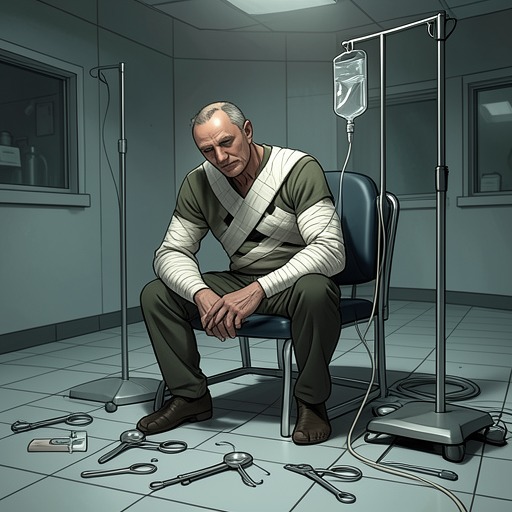
Carl Peterson
Naked LunchCarl Peterson is a citizen of Freeland whose appointment with Dr. Benway turns a routine-looking psychiatric examination into an exercise in coercive sexual classification. Carl enters expecting an administrative mistake; he leaves the encounter unable to make the door come closer. His episode shows how the state’s language of care can make surveillance and compulsion appear reasonable, even to the person subjected to them.
Identity and Setting
Carl receives a postcard instructing him to report at ten o’clock to Dr. Benway at the Ministry of Mental Hygiene and Prophylaxis. He doubts that the appointment could concern him, but also knows that the authorities do not make mistakes of identity. The summons carries no stated penalty for failing to appear. In Freeland, however, public provision reaches from bone meal to sexual partners, and that comprehensive benevolence itself stifles the idea of rebellion. The appointment is therefore powerful before the examination begins: the system need not announce a punishment to make its request difficult to refuse.
On the way to the Town Hall, Carl passes sixty-foot nickel figures washing themselves beneath showers and sees the glass-brick-and-copper cupola rising above the square. He also notices an American tourist who looks away and fumbles with the light filters of his Leica. The scene places Carl in a public landscape where bodies are displayed and observation is ordinary, while his own appointment will make him the object of a more intimate official gaze.
The Examination Begins
The office is silent and filled with milky light. Dr. Benway shakes Carl’s hand while watching his chest; Carl thinks he has seen the doctor before, though he cannot place him. He sits, crosses his legs, lights a cigarette, and regards Benway with a steady, faintly insolent composure. Benway fidgets over his papers before naming him and explaining that the state is trying to adjust itself to each citizen’s needs. The hesitations and sudden changes in volume make the language of individualized assistance feel unstable: care is presented as the state’s purpose, but Carl is the one being scrutinized.
Benway introduces sexual deviation as a misfortune or sickness, not something to censor or punish, then compares it with tuberculosis. From this premise he derives obligations for public health: just as authorities might require vaccination or isolate someone with a contagious disease, people with sexually transmitted illnesses may be compelled to receive treatment if they do not report voluntarily. Carl agrees that this sounds reasonable. The exchange matters because the coercion is not initially announced as coercion. It is recast as protection of others and as a minimum hardship compatible with public safety.
Benway then distinguishes the general public-health rationale from the department’s interest in sexual orientation. He says the authorities do not fully understand why some men and women prefer partners of their own sex, but regard the phenomenon as common and sometimes a departmental concern. Carl experiences the room as a place cut off from warmth and certainty; Benway’s expression appears at once predatory and impersonal. The clinical vocabulary and the oppressive atmosphere work together: the examination claims to describe a condition, while its methods place Carl under the power of the person defining it.
From Consultation to Investigation
When Carl asks what the examination is for, Benway compares it to a fluoroscopic examination requested in suspected tuberculosis cases. He presents a “psychic fluoroscope” as routine and says he expects the result to be negative. Carl replies that the procedure is ridiculous: he has been interested in women, has a steady girlfriend, and plans to marry. Benway answers that this is precisely why Carl is there, and compares a blood test before marriage to the investigation he is conducting. The stated reassurance thus becomes a reason to examine him rather than a reason to dismiss the suspicion.
Benway invokes a hereditary factor and social pressure, then digresses into possible connections with infantile environment, schizophrenia, cancer, and hypothalamic dysfunction. Carl dozes while this account continues. When he wakes, Benway describes a semen test as one diagnostic tool within a larger picture and sends him to a nurse, who gives him a jar and tells him to call when ready. The examination’s procedure converts a broad suspicion into an intimate specimen collection, despite Benway’s earlier assurance that the expected result would be negative.
Afterward, Benway announces good news and theatrically examines a slip of blue paper. Carl questions which test has been performed, exposing Benway’s shifting test names. The doctor dismisses the discrepancy with a titter and reports that the result is completely negative, suggesting that the department may not trouble Carl further. The negative finding does not end the interrogation. Instead, Benway turns to the file and asks about Carl’s sexual history, including how often and under what circumstances he has had sex with men. He suggests that never having done so would make Carl atypical, and the file appears to Carl to have grown to six inches thick. The document’s sheer scale gives the inquiry a life beyond the result: the negative test does not erase the suspicion or close the case.
Carl’s Resistance and the State’s Method
Carl explains that during military service men had propositioned him and that he had sometimes accepted when he was short of money. Benway readily excuses these encounters as understandable economic transactions, then presses him about occasions when money was not involved. This selective indulgence does not amount to acceptance. It lets the examiner sort Carl’s account into categories and continue searching for evidence that will sustain the investigation. The interview is structured so that denial, explanation, and admission can all be absorbed into the official inquiry.
The method echoes the state’s broader reconditioning practices. In Annexia, police searches are guided by mentalists toward whatever a person wishes to hide, and humiliating searches can turn planted objects into grounds for declaring someone deviant. In the Reconditioning Center, Dr. Benway describes procedures that include drugs, hypnosis, surveillance, and sexual humiliation; one reported technique encourages an agent to identify with a cover story until the former identity is made inaccessible. These scenes establish that the examination is not an isolated misunderstanding. It belongs to a system in which authorities use the language of diagnosis to produce the identities they claim merely to detect.
The Reconditioning Center’s criminal ward likewise defines a criminal as someone who does not deny the Freeland contract but tries to circumvent its clauses. Deviation is made a matter of administrative relation to the state, not simply of a discrete act. Carl’s examination applies the same logic to sexuality: Benway treats a private history as material to be elicited, categorized, and potentially made subject to intervention. The novel’s institutional satire lies in the distance between the calm vocabulary of routine care and the pressure exerted on the person being examined.
Ending and Significance
Carl insists that the situation is unreal and says he is leaving, adding that the authorities cannot force him to stay. Yet as he walks toward the door, numbness drags at his legs and the doorway seems to recede. Benway asks where he can go, his voice seeming to come from far away. The episode ends not with a reported diagnosis or a completed escape, but with Carl’s attempted refusal made physically ineffective. The narrative leaves the outcome unresolved while showing that the examination has already undermined his confidence and agency.
Carl’s encounter exposes a central contradiction in Freeland’s benevolent administration: the state describes its interventions as assistance, prophylaxis, and minimal hardship, while treating sexual difference as a reason for scrutiny and compelled examination. Benway’s verbal shifts—from sickness, to public protection, to a test, to a personal interrogation—show how medical categories expand to authorize state attention. Carl’s steady manner at the beginning and his diminishing ability to leave at the end mark the change from apparent composure to entrapment. The episode makes the examination itself the mechanism of control, whether or not the test returns a positive result.